Let Your Sword Do the Talking: Worldbuilding Through Your Magic Items
Beware the Info Dump!
I know the temptation as well as the rest of you! You spend many years meticulously crafting the history of your campaign setting, outlining the fall of ancient empires, the bloodlines of legendary kings, and the cataclysmic wars that shaped the earth. When your players finally arrive at a historic ruin, you want to tell them everything. You pull out your notes and deliver a massive, five-minute monologue explaining the truth of the world.
The problem? Players rarely retain info dumps. In a game of Dungeons and Dragons, characters engage with the world through action, discovery, and mechanical interaction. Putting a massive wall of text in front of them stalls the momentum of your game. Instead of simply telling your players the history of your world, you must show them, and one of the most effective ways to organically deliver deep lore without breaking the pace of play is through magic items.
A well-designed magic item communicates history instantly. When players spend their hard-earned time exploring a dangerous dungeon, the reward they find should be a physical manifestation of the world's past. You do not need to read a textbook to your players if you can simply hand them a powerful artifact that explains the history for you. If an ancient kingdom was destroyed by a frozen cataclysm, do not just tell the party—hand them a rusted dagger that constantly emits cold damage, its hilt wrapped in the frozen, perfectly preserved skin of a forgotten beast. In one moment, the players understand the lethal, freezing nature of the world's history simply by looking at their character sheet.
Integrating History into Every Magic Item
To successfully worldbuild through your loot, you need to examine four specific pillars of item design: mechanical abilities, material composition, physical location, and visual distinctiveness. Distinctiveness can be added to a magic item by using a generated origin that directly ties into the historic events of your setting.
The Mechanics of Storytelling
The actual rules and abilities of an item tell a story. Magic items in D&D are designed to encourage creativity and engagement from players, and their mechanical properties should reflect the culture that created them. If an ancient civilization of war mages valued tactical supremacy and intelligence gathering, their artifacts should naturally grant abilities like magic detection, bonuses to saving throws, or the ability to cast scrying spells as a bonus action.
If an empire was brutally oppressive, perhaps their weapons deal additional necrotic damage to a certain type of creature, or force the target to make a punishing save against fear. When players roll the dice and utilize these mechanics, they are actively participating in the lore of the world. The mechanics reinforce the narrative every single time an attack roll is made.
Material Composition Matters
What a magical object is made of speaks volumes about the region it comes from and the people who forged it. A weapon uncommon found in a sprawling desert should not be forged from standard steel. Instead, describe it as being carved from the hardened chitin of a massive scorpion, or forged from glass formed by lightning striking the sand.
If the party discovers an armor rare hidden deep within a fey-touched forest, it shouldn't look like standard plate. It should be woven from living silver thread and the bark of an ancient, petrified tree. When you write descriptions for your loot, focus on the raw materials. Players will immediately start asking questions about where these materials came from, seamlessly pulling them into the worldbuilding process.
Placement and Location
Where an item is found is just as important as what it does. A pristine, legendary wand resting on a velvet pillow in a heavily guarded vault tells a story of reverence and existing power. But finding that exact same wand snapped in half, clutched in the skeletal hands of a soldier who died alone in a muddy trench, tells a vastly different story of desperation, death, and lost hope.
Think critically about why a specific treasure is located where it is. Did the creator hide it to protect it from thieves? Was it lost in a sudden, catastrophic fire? Was it cast aside by someone who realized its power was corrupting their soul? The location provides the immediate context that makes the item cool and memorable.
The World of Sorkari: A Case Study
To demonstrate exactly how this works in practice, we will look at three custom items generated for the campaign setting of Sorkari, a setting written up just for this demonstration, but could be a very common setting for tables across the world.
Sorkari is a land dominated by massive, impassable mountain ranges that form an isolated, heavily protected valley in the center. Lore states that ancient gods built these mountain ranges to keep the mortal populace safe. However, long ago, god killed god in a bloody, apocalyptic civil war. Today, the mortal factions within the valley are beginning to divide and war amongst themselves. This sudden societal collapse was kicked off by an insidious curse started by an ancient lich. This curse was designed to make powerful leaders more angry, violent, and paranoid. The curse was so incredibly powerful that it destroyed the lich's phylactery in the process of casting, but its malignant force has worked slowly and surely ever since, poisoning the minds of Sorkari's rulers.
By analyzing the mechanics and lore of the items below, you can see exactly how the history of Sorkari is communicated directly to the players without a single lore dump.
No. 1: Staff of the Mountain Ward
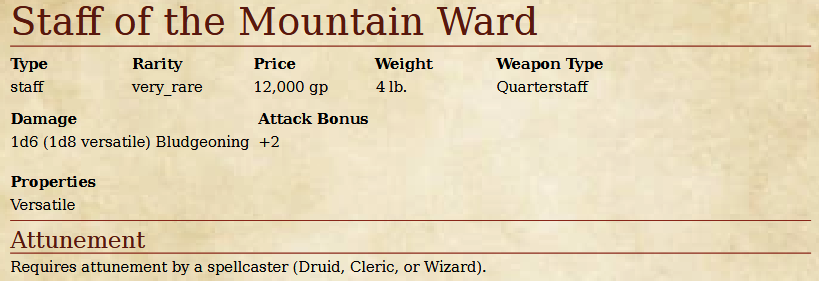
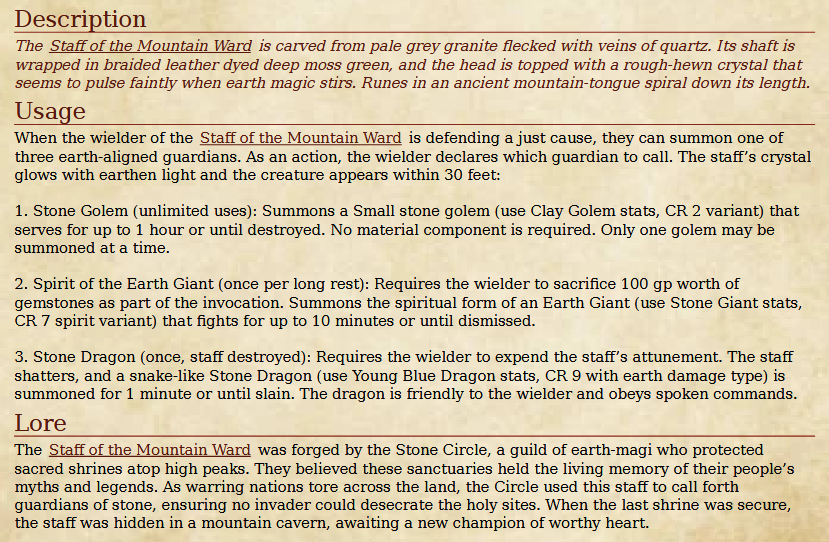
The Staff of the Mountain Ward is carved from pale grey granite flecked with veins of quartz. Its shaft is wrapped in braided leather dyed deep moss green, and the head is topped with a rough-hewn crystal that seems to pulse faintly when earth magic stirs. Runes in an ancient mountain-tongue spiral down its length, making it visually distinct from standard wooden staves. The sheer weight and rocky composition of this item immediately inform the player that it is tied deeply to the geological foundations of the world.
Forged by the Stone Circle, a guild of earth-magi who protected sacred shrines atop high peaks, this staff was used to call forth guardians of stone to ensure no invader could desecrate the holy sites. Mechanically, the wielder can use an action to summon a Stone Golem for an hour, sacrifice gemstones to call upon the Spirit of an Earth Giant, or permanently shatter the staff to unleash a Stone Dragon. This perfectly reinforces the lore of Sorkari's massive, protective mountain ranges and gives the players a tool to use in encounters.
A Dungeon Master should place this very rare staff deep within a high-altitude cavern or a ruined mountaintop shrine. Discovering it hidden away from the warring factions of the valley below tells the players that the ancient magi prioritized isolation and the preservation of history over modern political squabbles. Handing this to a druid or wizard allows them to actively play a role in defending the ancient, natural borders of the setting.
No. 2: The God-Glass Shard
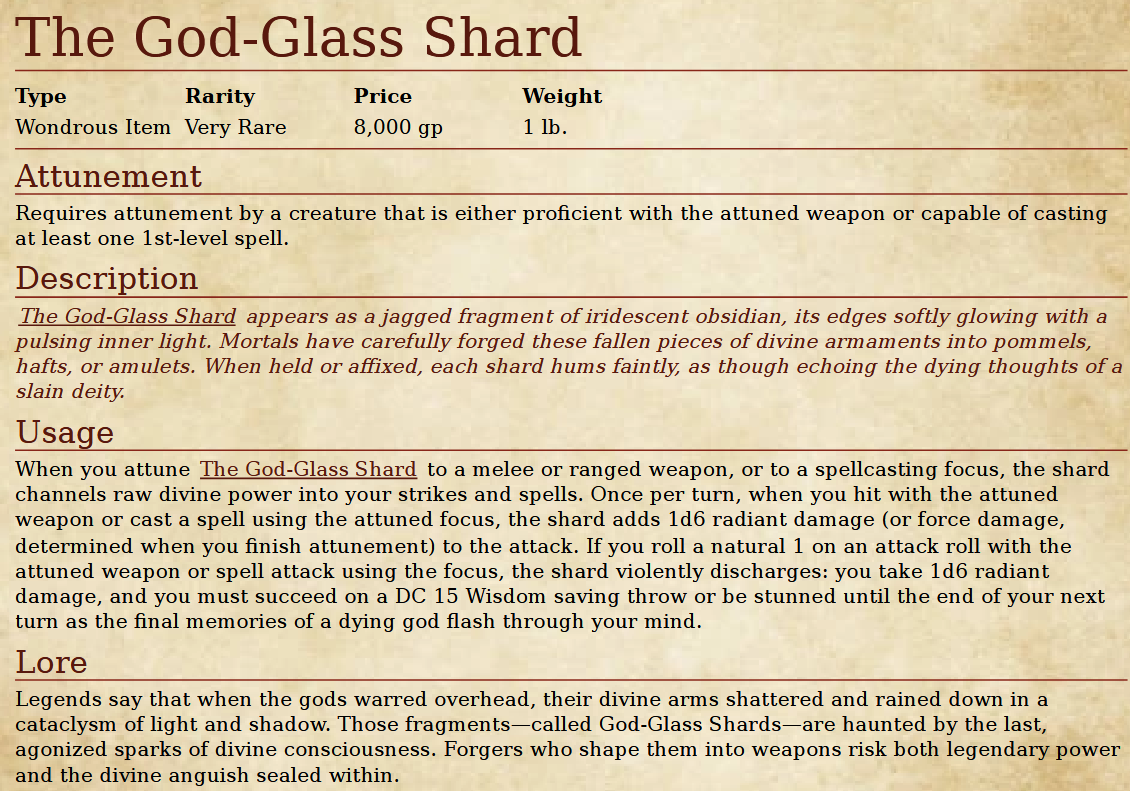
The God-Glass Shard appears as a jagged fragment of iridescent obsidian, its edges softly glowing with a pulsing inner light. Mortals have carefully forged these fallen pieces of divine armaments into pommels, hafts, or amulets. When held or affixed to a weapon or focus, each shard hums faintly, as though echoing the dying thoughts of a slain deity. This visual description instantly communicates the reality of the dead gods of Sorkari. The players are literally holding a fragment of the apocalyptic civil war in their hands.
When attuned to a melee weapon, ranged weapon, or spellcasting focus, the shard channels raw divine power, adding 1d6 radiant or force damage to a successful attack once per turn. However, the true narrative brilliance lies in its failure mechanic. If the user rolls a natural 1 on an attack roll or spell attack, the shard violently discharges. The user takes radiant damage and must succeed on a DC 15 Wisdom saving throw or be stunned as the final, agonizing memories of a dying god flash through their mind. This mechanic forces the player to experience the brutal history of the civil war firsthand. They don't just hear about the dead gods; they feel their death throes during combat.
These wondrous items should be found scattered across ancient battlefields or clutched in the hands of zealots trying to siphon their lingering power. They are the perfect reward to hand out to martial characters looking to upgrade their other weapons, offering a powerful boost with a severe, narrative-driven risk. It proves to the players that divine power in Sorkari is broken, volatile, and deeply dangerous.
No. 3: Shard of Malidreth
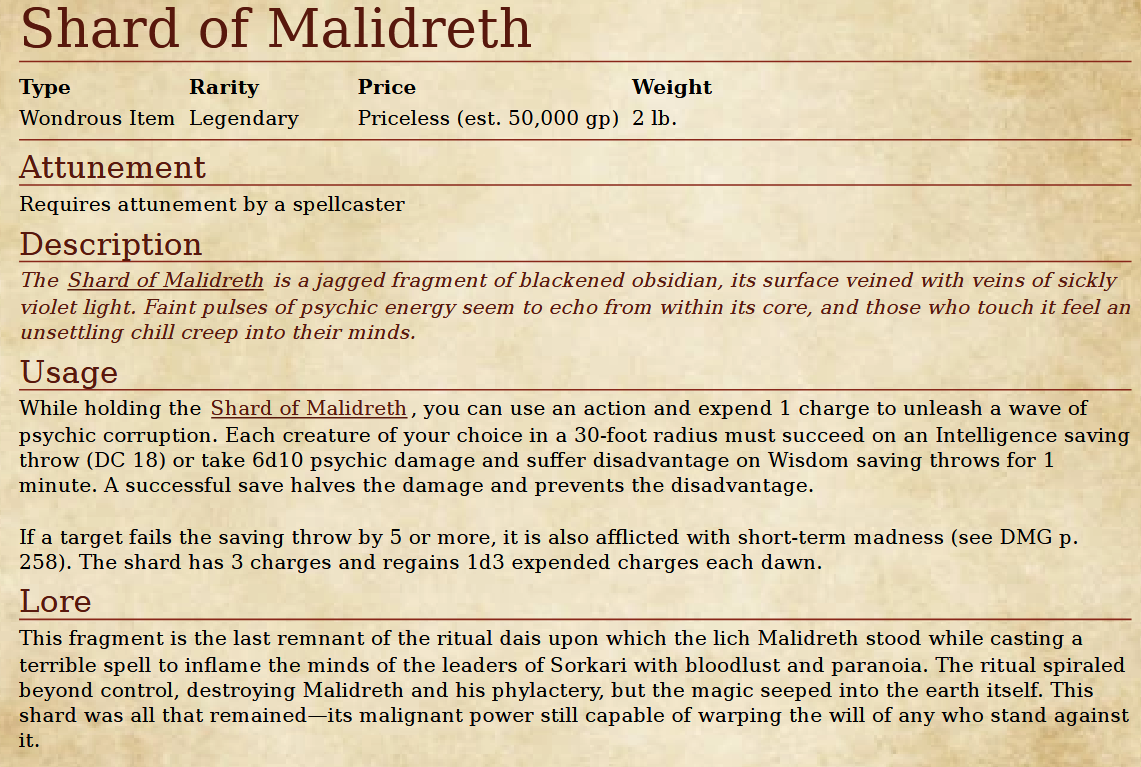
The Shard of Malidreth is a jagged fragment of blackened obsidian, its surface webbed with veins of sickly violet light. Faint pulses of psychic energy seem to echo from within its core, and any person who touches it feels an unsettling chill creep into their minds. While it might share a visual similarity to the God-Glass, the sickening violet hue and the immediate psychological discomfort clearly separate this item from the divine fragments, hinting at a much darker, corrupted origin.
This fragment is the last remnant of the ritual dais upon which the lich Malidreth stood while casting the terrible spell to inflame the minds of Sorkari's leaders with bloodlust and paranoia. While holding the shard, a player can use an action to unleash a wave of psychic corruption in a 30-foot radius. Enemies must succeed on an Intelligence saving throw or take 6d10 psychic damage and suffer disadvantage on Wisdom saving throws for a minute. If they fail the save by 5 or more, they are afflicted with short-term madness. This mechanic perfectly simulates the lich's curse. The player gets to weaponize the exact same paranoia and madness that is currently tearing the kingdom apart, turning a massive narrative plot point into a highly effective tactical advantage.
A Dungeon Master could place this legendary item at the epicenter of the lich's destroyed lair. Finding this shard amongst the blasted ruins of a phylactery proves to the players that the lich's spell was real, devastating, and entirely out of control. It is an incredible tool to give to an evil-leaning character or a desperate party willing to use dark magic to break an encounter, knowing full well they are wielding the very curse that is destroying their world.
Create Your World With a Magic Item Generator
Magic item generation tools can help Dungeon Masters create unique items for their campaigns without spending hours agonizing over the exact numerical balance. We built the WorldSmith magic item generator to empower you to design campaign-specific rewards that perfectly tie into your unique lore. Some magic item generators allow users to specify the origin or characteristics of the items they want to create, but WorldSmith deeply understands the underlying math and narrative structure of the game.
Not every reward needs to be a legendary artifact capable of leveling a city. A well-designed magic item can provide incredible utility and flavor for low-level parties. Whether you need a simple ring that grants a minor speed boost or an amulet that allows a player to cast a utility spell once a day, WorldSmith's magic item generator automatically calculates the correct prerequisites, modifiers, and limits. Magic item generation tools can enhance the gameplay experience by providing diverse and interesting items at every single tier of play, ensuring your players are always surprised and delighted by what they find in the dark corners of your dungeons.